Dr Di Beddow

Writer, Academic & Education Consultant

Category: Journalism

Lost ‘Waste Land’ 2

‘The awful daring of a moment’s surrender 

Which an age of prudence can never retract’ 

 What the Thunder Said 

 The Waste Land 


This morning I spoke on BBC Radio 4’s Today programme. The broadcast is running a summer holiday feature on treasured books and I wrote in to the programme with my sorry tale of my missing Eliot. 

Many of you will recall me banging on about this sad episode in my life each year in the ‘My Favourite Eliot’ slot of the Eliot Festival at Little Gidding. I read my chosen lines from the poem and then implore the audience once more to look inside any large, white editions of the transcript version of the poem, whether the book be in charity shops, secondhand bookshops, other people’s libraries, or online. 
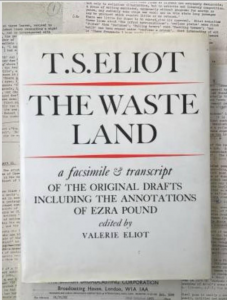
My father, who died twenty-five years ago, always told me that Education would be the ruination’ of me. On my eighteenth birthday though, he joined my Mum in writing and signing in a book I had asked for as a present. I had studiedThe Waste Landfor Alevel and I wanted the recently released big, white transcript edition of the poem, which my English teacher had pored over in lessons. It is the only book I have, or had rather, with that writing, that signing, that emblematic proof that my father did appreciate my passion for learning. 

I became an English teacher for my career and in a large secondary school in Cambridgeshire, a young teacher was struggling to engage her class with Eliot, so I lent her all of my Alevel books, covered in pencil comments and explanatory notes. And yes, I lent her my first edition, hardback copy of the transcript of The Waste Land. 

The books were never returned to me. 

I was promoted to another school, lost touch with the young teacher and since that date I have tried to track down my beautiful book with my late fathers writing. In the film version of Out of Africa I recall the Karen Blixen character, Meryl Streep, shocked to hear that Denys Finch-Hatton never spoke to a friend again after he had neglected to return a book loaned to him. Denys’s friend Cole relates how he asked Finch-Hatton, ‘You wouldn’t lose a friend over a silly old book would you?’ Denys apparently responded, ‘No, but he has.’ 

It is one of the regrets of my life, lending out that book. Frank Cottrell-Boyce and Katherine Rundell spoke recently on Today about their treasured books and the importance of the physicality of books and how they can become ‘talismanic’.This book is that to me. It evokes feelings of love for my proud, working-class father; for the power of teaching and also my gratitude to Jane O’Neill who taught me Eliot at the Cambridgeshire High School for Girls. It also symbolises for me my love of learning and literature, leading me to study the subject, then teach it and then return to it, as a student in early retirement, to gain my PhD. 

Please forgive me for my inability to move on from this loss. I remain hopeful that one day the book will find its way home, enlivening all my love for the work, my learning and my dear old Dad. 

Di Beddow 

5/8/2025 

Women who don’t help other women: myth or reality?

Women who don’t help other women: myth or reality?

In a world where we’re all supposed to be ‘leaning in’ and supporting each other, there are still women out there who don’t get it. And we should be thankful for them, says Di Beddow

At a workshop for women leaders in education recently, a colleague quoted Madeleine Albright; “there is a special place in hell for women who don’t help other women.”

Initially I laughed at this but then I realised while they might have been unhelpful at the time, I have learnt just as much from my negative role models as I have from those lovely, supportive, empowering examples.

The “Lean In” phenomenon pushes the importance of mentoring and encouraging others on the way up the ladder. However, even Sheryl Sandberg admits that she cringes when women come up to her and ask her to be their mentor.

“The strongest relationships,” she avows, “spring out of a real and often earned connection felt by both sides.”

Well of course they do, but we can have equally strong relationships with those we dislike. In fact, they often have a more powerful influence on us. They take up more of our thoughts and can come to dominate our lives if we let them. But while these relationships can be unhealthy, they can also teach us so much. They certainly have for me.

When my anti-mentor, Andrea, came new to the school in which I was working she seemed to good to be true. She bought me a bottle of wine on my birthday, offered me her successful application letter as a template for future job applications and in public she thanked me for all of my hard work. What more could a girl want?

Well, maybe a girl would prefer not to get e-mails, copied to the rest of the leadership team, telling her what she had got wrong that week. Highlighted in red, just in case I or anyone else missed it. I endured a year of this and it made me miserable. However, in hindsight, I learned an important leadership lesson from Andrea – might is not always right. Having power is a wonderful thing but how you use it is what matters.

My next experience came with Nora. She was a fantastically successful academic, who espoused in a glossy book on women’s leadership that her joy was mentoring women to their potential. At a crossroads in my career, I contacted her and asked if she had time to talk to me about her success and how I might find a way forward in her field. She agreed to see me and we had coffee in her study, where she slowly, and I hope unconsciously, pulled me apart.

“You may try…”, pause while she let me think about this, “but I doubt if you would get anywhere.”

Swiftly followed with, “You might enjoy writing, but you have had little success in the past few months.”

On walking away from her office I would happily have thrown myself into the Mill Pond, Woolf style, with a handful of pebbles in my pocket.

In the cold light of day, I know that I am a better person for the public criticism, for the half-hearted coaching. It says more about them than it does about me and it’s taught me what not to do in my own career. And when I begin to feel like I might still resent them, I remember that Madeleine Albright quote, and smile.

Article by Di Beddow published in the Guardian newspaper

What I wouldn’t give for the time to nurture eager young minds, writes Di Beddow

What I wouldn’t give for the time to nurture eager young minds, writes Di Beddow

I’m very excited by the prospect of universities once again being part of the development of A levels. Here in Cambridge we have the wonderful Classics professor Mary Beard, who blogs and writes books on being a don. She recently took her long, silvery locks around the ruins of Rome to tell television viewers what the Romans did for us. In her most recent article for the local paper, she describes her day from 6am until 11.30pm. It is, I would think, every sixth-form teacher’s idea of educational paradise. She rises; checks for incoming essays via email; cycles through the lanes to work; lectures; tutors a PhD student; discusses the impact of her research at the faculty’s planning committee; and supervises groups of two or three undergraduates for an hour at a time. It is a long and demanding day, but it appears to be focused on reading, writing, thinking, analysing, responding, creating and, most of all, enjoying her subject.

If Beard were given more say in A-level programmes of study and assessment, I am convinced that we would have a more demanding, productive and exciting couple of years with our students at school. We might well achieve what David Eastwood, vice-chancellor of the University of Birmingham, describes as the goal of the new A-level system: “… young people stretched to achieve more than they yet know possible”. “Huzzah!” I want to shout. “Let’s do it! Let’s put the show on right here!”

And then I think of my day. Much like Beard’s, it runs from 6am until 11.30pm. No time to check for essays in the morning, because students must be settled in for the day ahead. There is uniform to be checked; assemblies to lead; tutor groups to monitor; pupils to be mentored in the run-up to their GCSEs.

Then there is the teaching. Unlike most of my colleagues, I have only a small teaching load because of my leadership responsibilities. I love teaching and have not given it up even while acting as head over this summer term. I have a bright, vibrant and demanding A-level literature group that expects the very best from me in preparation, objectives, plenaries, setting and marking essays. On occasion, one particularly gifted boy asks a really interesting question about one of our texts. Beard describes a similar experience in her day: “These smart students have all kinds of tricky questions… The Crito is about whether you have a duty to obey the laws even if you believe they are wrong. It’s a question that speaks to them.”

My Joe does the same. “Miss,” he begins, pausing for effect while the rest of the class settles down to watch the exchange. “If God is genuinely loving and Adam and Eve are his children, should He not really give them a second chance after the old apple-eating thing?”

On another occasion, he asked this about Paradise Lost: “Where exactly is Hell? Is it underground? If it is underground, how come the fallen angels do not career into the Earth’s crust as they fall? Is there any mention in the Old Testament of them being thrown out of Heaven, falling and then sort of drilling down through the layers of the Earth until they end up in Hell? Or is Hell perhaps a completely different planet, Miss?”

How I wish I could sit down, halt the relentless school timetable and enter into such fascinating explorations. Instead, I usually deliver a closing, summative statement that acknowledges the fascinating query, but moves swiftly on to: “… and next week’s timed essay in preparation for your closed book examination is … “.

With budgets biting hard, it is difficult for us to split A-level classes into small groups and even harder to find the time to spend on one-to-one feedback on essays, coursework, revision and the like. Michael Gove may well be on to something with his closer relationship between A-level syllabuses and university demands, but please, Mr Gove, could we have the finance to match Beard’s day of lectures, consultation, debate and tutorials as well?

An article by Di Beddow reported in TES.

Di Beddow © 2023 Frontier Theme